
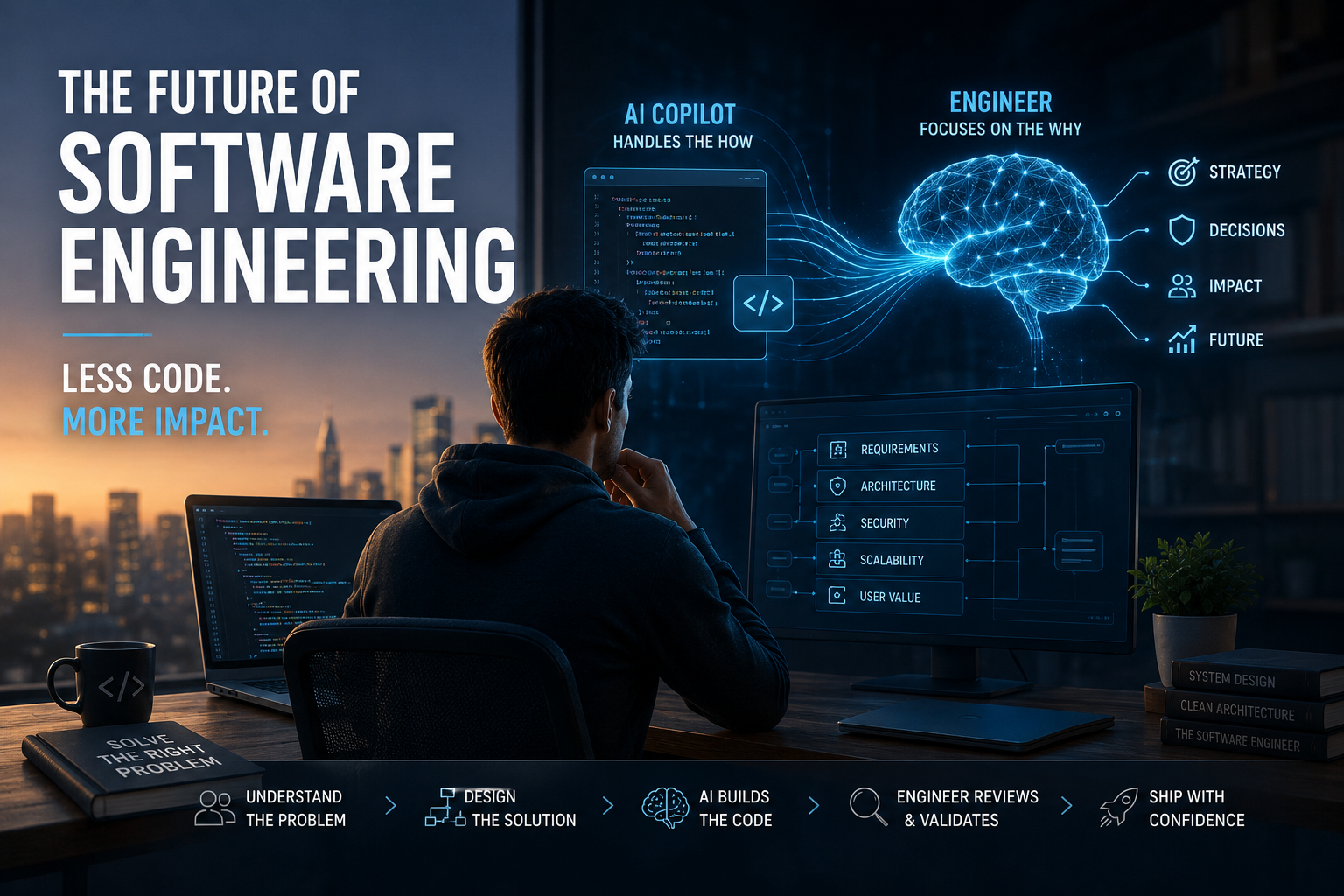
For the past two years, software development has been dominated by one question:
Can AI replace software engineers?
The answer, increasingly, is no—but not for the reason many people expected.
AI has become exceptionally good at writing code. It can generate APIs, scaffold applications, build CRUD systems, write unit tests, and even explain complex algorithms. Tasks that once took hours can now take minutes.
Ironically, that hasn’t made software engineering less valuable.
It’s made engineering more important than ever.
The Rise (and Limits) of AI Coding
The emergence of large language models fundamentally changed software development. Developers no longer spend most of their day typing boilerplate or searching Stack Overflow. Instead, AI handles much of the repetitive implementation work.
This has created a phenomenon often referred to as vibe coding—describing what you want and allowing an AI assistant to generate large portions of the application.
For prototypes, internal tools, and personal projects, it’s remarkable.
But production software is an entirely different challenge.
The difficult part of engineering has never been writing syntax.
It’s understanding systems.
Code Was Never the Hard Part
Most failed software projects don’t fail because someone forgot a semicolon.
They fail because of:
- Poor architecture
- Weak requirements
- Scalability problems
- Security vulnerabilities
- Technical debt
- Distributed systems complexity
- Business misunderstandings
None of these problems disappear because an AI generated the code faster.
If anything, they’re becoming more common.
When developers can generate thousands of lines of code in minutes, they can also generate thousands of lines of technical debt just as quickly.
Velocity without judgement simply creates problems faster.
The New Role of the Software Engineer
The software engineer of 2030 won’t be measured by typing speed.
They’ll be measured by decision quality.
Increasingly, engineers will spend their time asking questions like:
- Should this system even exist?
- What’s the simplest architecture?
- Where are the security risks?
- Which trade-offs matter?
- How will this evolve in three years?
- What happens when millions of users arrive?
These are engineering questions—not coding questions.
AI can recommend solutions.
Engineers decide which ones are worth building.
Context Is Becoming the Competitive Advantage
One of AI’s biggest limitations is context.
An AI model doesn’t automatically understand:
- Your company’s history
- Previous architectural decisions
- Internal politics
- Regulatory requirements
- Customer behaviour
- Product strategy
Humans do.
The best engineers increasingly act as translators between business problems and AI-assisted implementation.
Instead of writing every line themselves, they orchestrate systems, validate outputs, and ensure everything aligns with long-term objectives.
That shift resembles the evolution of civil engineering.
Modern engineers don’t manufacture every brick.
They design structures that remain standing decades later.
Software is heading in the same direction.
Small Teams Will Build What Large Companies Once Needed Hundreds For
This may be the most transformative consequence of AI.
A startup of five experienced engineers, equipped with modern AI tooling, can now achieve output that previously required teams of twenty or thirty.
That doesn’t necessarily eliminate jobs.
It changes where value is created.
Companies will increasingly optimise for:
- Better judgement
- Faster decision-making
- Stronger product thinking
- Higher-quality architecture
- Deeper customer understanding
The bottleneck shifts from production capacity to strategic clarity.
Senior Engineers Become Multipliers
For years, experience primarily meant writing better code.
Now it means directing AI effectively.
Senior engineers know:
- When AI is wrong.
- When generated code introduces hidden complexity.
- When simplicity is preferable to sophistication.
- When a problem shouldn’t be solved with software at all.
This creates an interesting paradox.
Junior developers may experience the largest productivity gains from AI, but experienced engineers often extract far greater value because they can recognise subtle flaws before they become expensive failures.
Experience compounds AI’s usefulness.
The Skills That Will Matter Most
The engineers who thrive over the next decade won’t necessarily be the fastest coders.
They’ll excel at:
- Systems architecture
- Security engineering
- Performance optimisation
- Cloud infrastructure
- Product thinking
- Communication
- Requirements analysis
- AI orchestration
- Technical leadership
Notice what’s missing.
Typing.
The keyboard is becoming less important than the decisions made before anyone touches it.
AI Isn’t Replacing Engineers. It’s Raising the Bar.
Every major technological shift follows a familiar pattern.
Calculators didn’t eliminate mathematicians.
Power tools didn’t eliminate builders.
Spreadsheets didn’t eliminate accountants.
They elevated expectations.
AI is doing the same for software engineering.
Tomorrow’s engineers won’t be judged by how quickly they can implement a feature.
They’ll be judged by whether they’re building the right feature, in the right way, for the right reasons.
That’s a much harder problem to solve.
And that’s exactly why software engineering isn’t disappearing.
It’s evolving.
Leave a Reply